Recently announced was Nintendo's next generation console: the Wii U.
A lot of buzz has been generated around the new console, and with good reason.
Begin a long time fan of Nintendo, I am highly intrigued by the new console. It supports a new array of features, including an innovative touch screen controller and high definition game support.
The funny thing is, I remember reading an article a number of years back that suggested a touch screen controller was among the first prototypes for the Wii; but they decided against it due to fear of imitating the DS too much....I have no idea if that's true or not; but if so this certainly seems an interesting turn of events!
I'm glad to hear that the Wii U will support Wii games and all current Wii-based controllers (classic controller, balance board, etc); although this rumored concept of only one Wii-U Tablet controller per console sounds limiting; Nintendo might just figure out a way to make it work (they could also change their mind on this as supposedly it's already been suggested that you could bring your controller over to a friends house).
But what I really want to talk about is legacy game support on the Wii U. My understanding is that the Wii support for GameCube games is due to having an on board GameCube processor, of which the GC controller ports and GC Memory Cards are wired into (but also have an inturrupt to the Wii processor so they can be used by Wii software as well).
My experience when playing a GC game on the Wii has been just that: it basically acts just like a GameCube and is indistinguishable from the original console. It bypasses the Wii processor altogether.
It is obvious to see why it's tempting to remove GC support: removing the processor leaves more room in the chassis for newer, powerful processors and makes the console cheaper by not having to manufacture a second processor. Plus, the GameCube console is over 10 years old and approaching obsolescence.
But I think there's a very good case for providing GC support on the Wii U, in some form or another.
When the Wii came out with GameCube support, most people were pretty happy that they could ditch their GC with ease, why have two consoles when you can have just one? But then came the real kicker: There was also going to be a Virtual Console which would allow you to play games from the NES, SNES and N64 consoles. I think this, more then GameCube support, really set our imaginations a flame: any Nintendo fan will tell you how much they love the charm and nostalgia of the classic Nintendo games. Playing our favorite classics on a modern, updated console, without having to blow on the cartridge 50 times? Queue the drool in 3....2....1....
But Nintendo did more then they realized when they announced the Virtual Console: they set a precedent. For once; a company was saying "We stand by our old work; we want you to enjoy it as you always did, now and for years to come." It wasn't that you could only play Nintendo Wii games, but you could play nearly the entire Nintendo home console library: NES+SNES+N64+GC+Wii. From that point on, I was left with an potentially dangerous expectation: consoles should only add functionality onto their predecessors and never remove functionality (or at least, remove the minimum possible, only where it would significantly conflict with the design of the next console: e.g. the GameBoy Player on GC).
As a result, I imagined the Wii as less of gaming console and more of a gaming hub: a device that could support many different types of games from many different types of systems. As a fan of removing redundancy, this was a very exciting prospect, and a trend I personally expected to continue into future consoles such as the Wii U.
So then another question presents itself: Will the Wii U support Virtual Console titles?
Although no official word on this has been presented, I'll be fairly shocked if the answer is anything other then "Yes."
If my assumption is correct, then let's look at the list of consoles of the Wii U would support:
NES
SNES
N64
Wii
Wii U
with one glaring omission: the GameCube!
Why would you develop a console that A) Supports the 3 oldest consoles; B) Supports the 2 newest console, but C) Simply decides to ignore the 4th console in the middle?
It doesn't make a heck of a lot of sense to me. Thus, I think the Wii U should absolutely add some level of support for GameCube games, if nothing else, so that it doesn't feel like they are pointlessly skipping a console in their gaming library (supporting all consoles except one).
Now, I'm not saying the Wii U has to support GC games in the same way the Wii does (use a GC chip, have on board GC controller & Memory card slots).
But there are lots of other ways they can add GC support. One of the most obvious ways is to include GameCube games onto the Virtual console. As for controllers perhaps sell an optional adapter to connect the GC controller to USB, and run the GameCube games with emulation (I'm going to assume the Wii U's processor would be powerful enough to run GC emulation software).
Another option is to sell some sort of "mini-GameCube" device for a cheap price that includes GC ports, a disc reader and memory card slots and connects to the Wii U but is otherwise an empty shell that relies on the Wii U for processing: a "GameCube player" or sorts if you will.
There are hybrid approaches as well: allow the Wii U to read GC discs natively, but not include the ports on board but only via an optional mechanism and run the games through emulation. Heck, I'm sure you could figure out a way to connect a GC controller with a Wii-U controller or even a Wii Remote!
Point is, there are lots of different ways to do it; and no serious excuse for not doing it. The absolute minimum I would like to see is GC games on the Virtual Console and support for playing them via the Wii's Classic Controller (which we know to be supported). But this presents a problem: as much as I am a fan of eliminating the need for multiple devices (see my previous post on the subject), I am not of fan of needing to purchase the same things multiple times. In fact, I fully expect a migration tool for porting your Virtual Console purchases from the Wii to the Wii U (again, Nintendo set a precedent for this by announcing you could transfer DSi games to a 3DS).
What I think would be a great option for Nintendo and consumers is to allow a "trade in service" where people could send in older games and receive a credit to get the same game (or an equivalent in Nintendo Points) on the Wii (-U) Shop Channel. You could do this for GC discs, N64 cartridges, etc. Nintendo could recycle the components to make new games/equipment while the consumer would not have to purchase the same thing twice. I really wanted to see this materialize with the Wii Virtual Console, but it never did. However, if more of Nintendo's legacy games continue to wind up on the Virtual Console, I feel it's becoming more of a necessity.
So, not saying any of this is going to happen, but it's a possibility. Would lack of GC support altogether stop me from purchasing a Wii U? Probably not, but it gives me less of an incentive knowing that I'd need to hold onto my Wii (or GameCube) as well. Obviously Nintendo is a company first, with a revenue line to think about, without which they can't produce new consoles and games. But I seriously hope Nintendo continues to put their customers first, which I feel to date they have been doing a good job of. In the end, it will be more profitable for them since it will make many of us, including myself, more likely to purchase their games and equipment.
It makes no sense for the Wii's successor to not support Virtual Console games and it makes even less sense for Nintendo to simply ignore GameCube in the list of consoles the Wii U supports.
Let's hope Nintendo sees it that way too.
Tuesday, July 12, 2011

Sunday, June 19, 2011
Project: Starry Expanse
Happy Sunday everyone!
When I was kid, I was very interested in the "Myst" franchise. It was a very challenging game: you needed to figure out what to do each step of the game with no real direction. My friend and I played it for about 2 months before finally getting to the end.
It was followed by a sequel, called Riven, which if anything was 10 times more challenging.
There were 3 more sequels to the original, but made by difference companies. They were fun names nonetheless, but never really had the charm and appeal of the originals Myst&Riven.
Myst&Riven were "semi-3D", basically a series of still images that you clicked on to go the next still. You could click to move forwards, up, down, left, right, to give you an artificial feeling of being in a 3D environment. Given the limited technology at the time (circa. 1993), this was pretty ground breaking.
Later, a remake of the original was created called "realMyst". Gameplay was nearly identical to the first, but instead of still images, the game was recreated with a brilliant 3D engine allowing for full range of access across the environment, day/night effects, weather effects and more.
It was very exciting and while playing realMyst it gave me a wonderful feeling of nostalgia + intrigue. "This was the way Myst was meant to be played..." I said to myself. The idea was just ahead the technology at the time.
But my thoughts immediately jumped to the next most logical question: Would there ever be a realRiven?
Myst was later re-released to multiple platforms including the DS, PSP and iPhone.
Unfortunately, they seemed to only like releasing the good old-fashioned "still-based" navigation system, rather then an immersible 3D environment. Personally, I never understood this choice, as the immersible environment I felt would have a better chance of bringing in new fans.
Logically, if they did that, realRiven could follow (and possibly with game 3&4, 5 was already based on the full 3D environment).
But no 3D remakes of the other games never surfaced. Why? I cannot stay, but that hasn't stopped a group of fans from recreating the sequel in 3D themselves!
The project is called Starry Expanse. If you're a Myst fan you'll get the reference. If not, go get yourself a copy of realMyst (I believe it's on Steam), beat it, and then you'll get the reference.
This is a very neat project! Recreating a game in real time 3D is no small feat, so I wish them the best of luck. You can even make a donation on their site (I did) and get your name in the Credits!
Check out their site for more info. It's a really great project and will hopefully help open Myst & Riven to a new world of fans.
Take care!
When I was kid, I was very interested in the "Myst" franchise. It was a very challenging game: you needed to figure out what to do each step of the game with no real direction. My friend and I played it for about 2 months before finally getting to the end.
It was followed by a sequel, called Riven, which if anything was 10 times more challenging.
There were 3 more sequels to the original, but made by difference companies. They were fun names nonetheless, but never really had the charm and appeal of the originals Myst&Riven.
Myst&Riven were "semi-3D", basically a series of still images that you clicked on to go the next still. You could click to move forwards, up, down, left, right, to give you an artificial feeling of being in a 3D environment. Given the limited technology at the time (circa. 1993), this was pretty ground breaking.
Later, a remake of the original was created called "realMyst". Gameplay was nearly identical to the first, but instead of still images, the game was recreated with a brilliant 3D engine allowing for full range of access across the environment, day/night effects, weather effects and more.
It was very exciting and while playing realMyst it gave me a wonderful feeling of nostalgia + intrigue. "This was the way Myst was meant to be played..." I said to myself. The idea was just ahead the technology at the time.
But my thoughts immediately jumped to the next most logical question: Would there ever be a realRiven?
Myst was later re-released to multiple platforms including the DS, PSP and iPhone.
Unfortunately, they seemed to only like releasing the good old-fashioned "still-based" navigation system, rather then an immersible 3D environment. Personally, I never understood this choice, as the immersible environment I felt would have a better chance of bringing in new fans.
Logically, if they did that, realRiven could follow (and possibly with game 3&4, 5 was already based on the full 3D environment).
But no 3D remakes of the other games never surfaced. Why? I cannot stay, but that hasn't stopped a group of fans from recreating the sequel in 3D themselves!
The project is called Starry Expanse. If you're a Myst fan you'll get the reference. If not, go get yourself a copy of realMyst (I believe it's on Steam), beat it, and then you'll get the reference.
This is a very neat project! Recreating a game in real time 3D is no small feat, so I wish them the best of luck. You can even make a donation on their site (I did) and get your name in the Credits!
Check out their site for more info. It's a really great project and will hopefully help open Myst & Riven to a new world of fans.
Take care!
Saturday, February 19, 2011
The Length of a Calendar Day
Happy 2011! Hope you all have a great year.
Just for the record, I don't have any New Years Resolutions. I have minor modifications to my behavior that I intended to implement coincidentally on January 1st. That's totally different. Right? :)
But just how long *is* January 1st? While down visiting my friends and family over the holidays, this question was posed to me.
Now of course, the answer seems completely obvious. 24 hours. Right? Some might argue the day isn't quite 24 hours, given various rotation periods, or only considering hours of "daylight" etc. But in general, the length of day being defined by the Earth's rotational period is 24 hours. But that wasn't the topic of discussion, rather, this one referred specifically to timezones.
That is, given that different parts of the planet can register the calendar being different days at the same time, how long does *somewhere* on the planet register a specific day?
Take January 1st for instance. I celebrated New Years at 12:00 AM January 1st, Local time. My particular time zone is UTC-4 (aka GMT-4), so by the time it was January 1st for me, it was already January 1st for more than half the planet. So how long, in hours, did January 1st last from the first moment somewhere on Earth registered it, until the last place on Earth clicked over to January 2nd?
The Simple Answer
Let's imagine we break the Earth symmetrically by time zone:
 In this simplified model, the day would first "dawn" in UTC+12. It would turn 12:00 am January 1st, 2011 first in UTC+12, then 1 hour later progressively across the planet. The interesting thing is what happens when you go the *other* direction, that is directly from UTC+12 to UTC-12. This is called the International Date Line and works like so, if you cross it traveling west, then the time remains the same but you increment a day to the date. If you cross it going east, the time still remains the same, but the date decrements a day. Thus, If it's 12:00 AM on January 1st in UTC+12, then it's 12:00 AM on December 31st in UTC-12. Using this, we can extrapolate a simple chart like so:

With this model, UTC+12 would be the first place it becomes January 1st, and it would last for 24 hours, the entire time it would be December 31st in UTC-12. Once January 1st in UTC+12 clicks over the January 2nd, the International Date Line tells us that UTC+12 is now January 1st, which it has another 24 hours as Jaunary 1st. The various time zones in between would have their day in between the two extremes, but we don't need to consider the overlapping periods to answer this question. Thus, in this sense it would be January 1st somewhere on the planet for a total time range of 48 hours. Kinda neat, huh?
But not quite...
The simplified model postulated above helps us to think about the problem, but isn't quite the solution. It implies that there are 24 equally distributed time zones (not including UTC), which isn't quite the case.
Granted, there are timezones that are not offset on the hour, UTC -3:30 (Newfoundland Time) for example. But these don't matter for this analysis, since they are still within the UTC+12 and UTC-12 extremes.
The problem is that UTC+/- 12 aren't necessarily the extremes. In fact, there are two additional time zones that need to be considered, UTC+13 and UTC+14. So indeed, UTC+14, rather then UTC+12, is the first place the day clicks over.
What does this imply for our analysis? Well, think about it this way, we've started that there's a total 48 hour window between the period the day dawns in UTC+12, then ticks over the next day in UTC-12.
But, by the time the day clicks over in UTC+12, it's already been that day in UTC+14 for two hours now. And so, we must add on these two hours to the 48 window for a grand total of 50 hours being the length of a calendar day.
Wow, 50 hours!
Indeed! Quite a bit more then the usual 24. However, there's still one other aspect we haven't considered yet: Daylight savings time.
The analysis presented above assumes that all timezones (by which I mean UTC offsets) remains the same throughout the year. This is of course not true. I'm currently in my local timezone of UTC-4, however, for a number of months throughout the year while DST is in effect, I'll in fact be UTC-3 instead.
Daylight savings generally follows a simple rule: Fall back, spring ahead. Thus, during the Fall/Winter months, you are in your "normal" timezone, but during DST, you are one more hour ahead then usual. This means that if you are west of the Prime Meridian, you get one hour closer to UTC (-4 becomes -3), and if you are east of the Prime Meridian, you get one hour farther away (+4 becomes +5).
How does this affect our analysis? Let's consider what this would do at the extremes we've established:
Standard | DST Offset
---------|-----------
UTC + 14 | UTC + 15
UTC - 12 | UTC - 11
This might not seem to affect our counts at all, and in this case, you'd be correct. We might be gaining an hour moving to UTC+15, but we're losing an hour off the other end, keeping the count to our previous count of 50 hours.
The interesting thing is that, while DST offsets us by an hour, not all places observe it. This creates a few interesting scenarios.
For example, presume that there exists a place in UTC+15 that does observe Daylight savings time, but a place in UTC - 12 that does not observe daylight savings time. The resulting effect would be that the UTC+15 and UTC-12 timezones were in effect simultaneously, in fact resulting in a 51-hour day.
Likewise, the opposite could be true. Imagine that there is a place in UTC+14 which does not observe daylight savings time, and that there were no places in UTC-12 which did not. This would cause us to run from UTC-11 to UTC+14 simultaneously, resulting in a 49-hour day.
My research so far however indicates that the only place I'm aware of using UTC+14, a country called Kiribati, uses UTC+14 all year round, so in fact never offsets to UTC+15. So unless I'm incorrect on that, or it changes in the future, we can rule out a 51-hour day.
In addition, according to Wikipedia with regards to UTC-12, there are in fact no human habitations in this timezone. Instead, the timezone is nautical only, observed by ocean ships which happen to be crossing through it. And I highly doubt that they bother to observe DST, or even if some did, that all would.
Thus, year round we likely have a UTC-12, which is the last part of the planet to observe a calendar day.
So even though DST could affect our analysis of a calendar-day length by an hour, due to the decisions of local (or non-existent) jurisdictions, they do not. At least for now, the length of calendar day observance remains at 50 hours, year round, regardless of local DST offsets.
Why Timezones?
To wrap up this post, a short discussion on why we use timezones at all. If you are Canadian (or even interested in the subject at all) you are likely familiar with the Sir Sandford Fleming Heritage Minute. Fleming was an railway engineer, who was fed up by the ridiculous "minute" offsets of various timezones between cities. This was because each various location liked to have noon the time when the sun was "overhead", making the setting of time as one traveled by rail very inconvenient.
So Fleming came up with a different idea: Standardized time. Dividing the world into roughly 24 equal sizes areas, it was now far, far easier to communicate times across the world and have them be relevant and make sense.
Although it took him some time to get it widely accepted and adopted, Fleming's invention of Standard time was nothing short of genius. It was likely as important as the railway and telegraph themselves in modernizing the industrialized world.
But Fleming only reduced the number of timezones. He shrunk the number back by a pretty significant amount, but didn't eliminate them completely. Why?
To me, the elimination of timezones would seem to be the next logical step. As a computer programmer, I can tell you that writing and dealing with software that needs to operate in different timezones can be challenging. You always need to be conscious of what time you are working with, is it local or UTC, how much does it need to be offset by, is it daylight savings time or not, etc. Doing comparisons can also be tricky, and since various programmers do things in different ways, sometimes cooperating between different programs and programmers just complicates things more.
Imagine that, if instead of having timezones, everyone on the planet simply used the single timezone, say UTC. The benefit of this would be that there would no longer be any ambiguity when communicating timezones across the planet. March 1st at 12:00 pm would be March 1st at 12:00 pm everywhere.
Locally, things might seem a little odd at first. For example, people in Greenwich might go to work at 9 am and get home at 5 pm, while people in Halifax might to work at 1 pm and get home at 9 pm.
But what real difference would that make? Sunrise would just "happen" to be at 10 am instead of 6 am, but so what? I dare say that if such a system were to be adopted, it would probably only take a generation or so, perhaps less, for everyone to become accustomed to it. I'm sure our biological clocks would adjust, same as they did for Standard time. You would still have to do some mental calculation offsets on occasion for specific things, but probably not as many.
Just look at the transition of most countries (US not withstanding) to adopt Metric over Imperial measurements. I, for one, certainly can't think or estimate in miles or quartz. I'm not too bad with inches and feet, but only because when I used to help my Dad with upholstery or construction, he made sure I read the measuring tape in inches. I do know my own height in both centimeters and mass in kilograms, and generally get pretty confused dealing with Fahrenheit.
But those are just my personal preferences. Getting international cooperation on such a scheme would prove very difficult, just look at the opposition Mr. Fleming ran into. And countries are far less willing to adopt such things even today.
Nevertheless, I think it's a neat idea with a number of benefits, even if its never actually adopted. What about you? What might be some other pros to such an approach? What might be the cons and downsides of it?
Leave your thoughts and opinions in the comments and below, and feel free to correct me on any of my calculations if you feel I made a mistake in my calculations on the length of a calendar day.
Best wishes, and take care!
Just for the record, I don't have any New Years Resolutions. I have minor modifications to my behavior that I intended to implement coincidentally on January 1st. That's totally different. Right? :)
But just how long *is* January 1st? While down visiting my friends and family over the holidays, this question was posed to me.
Now of course, the answer seems completely obvious. 24 hours. Right? Some might argue the day isn't quite 24 hours, given various rotation periods, or only considering hours of "daylight" etc. But in general, the length of day being defined by the Earth's rotational period is 24 hours. But that wasn't the topic of discussion, rather, this one referred specifically to timezones.
That is, given that different parts of the planet can register the calendar being different days at the same time, how long does *somewhere* on the planet register a specific day?
Take January 1st for instance. I celebrated New Years at 12:00 AM January 1st, Local time. My particular time zone is UTC-4 (aka GMT-4), so by the time it was January 1st for me, it was already January 1st for more than half the planet. So how long, in hours, did January 1st last from the first moment somewhere on Earth registered it, until the last place on Earth clicked over to January 2nd?
The Simple Answer
Let's imagine we break the Earth symmetrically by time zone:
 In this simplified model, the day would first "dawn" in UTC+12. It would turn 12:00 am January 1st, 2011 first in UTC+12, then 1 hour later progressively across the planet. The interesting thing is what happens when you go the *other* direction, that is directly from UTC+12 to UTC-12. This is called the International Date Line and works like so, if you cross it traveling west, then the time remains the same but you increment a day to the date. If you cross it going east, the time still remains the same, but the date decrements a day. Thus, If it's 12:00 AM on January 1st in UTC+12, then it's 12:00 AM on December 31st in UTC-12. Using this, we can extrapolate a simple chart like so:
With this model, UTC+12 would be the first place it becomes January 1st, and it would last for 24 hours, the entire time it would be December 31st in UTC-12. Once January 1st in UTC+12 clicks over the January 2nd, the International Date Line tells us that UTC+12 is now January 1st, which it has another 24 hours as Jaunary 1st. The various time zones in between would have their day in between the two extremes, but we don't need to consider the overlapping periods to answer this question. Thus, in this sense it would be January 1st somewhere on the planet for a total time range of 48 hours. Kinda neat, huh?
But not quite...
The simplified model postulated above helps us to think about the problem, but isn't quite the solution. It implies that there are 24 equally distributed time zones (not including UTC), which isn't quite the case.
Granted, there are timezones that are not offset on the hour, UTC -3:30 (Newfoundland Time) for example. But these don't matter for this analysis, since they are still within the UTC+12 and UTC-12 extremes.
The problem is that UTC+/- 12 aren't necessarily the extremes. In fact, there are two additional time zones that need to be considered, UTC+13 and UTC+14. So indeed, UTC+14, rather then UTC+12, is the first place the day clicks over.
What does this imply for our analysis? Well, think about it this way, we've started that there's a total 48 hour window between the period the day dawns in UTC+12, then ticks over the next day in UTC-12.
But, by the time the day clicks over in UTC+12, it's already been that day in UTC+14 for two hours now. And so, we must add on these two hours to the 48 window for a grand total of 50 hours being the length of a calendar day.
Wow, 50 hours!
Indeed! Quite a bit more then the usual 24. However, there's still one other aspect we haven't considered yet: Daylight savings time.
The analysis presented above assumes that all timezones (by which I mean UTC offsets) remains the same throughout the year. This is of course not true. I'm currently in my local timezone of UTC-4, however, for a number of months throughout the year while DST is in effect, I'll in fact be UTC-3 instead.
Daylight savings generally follows a simple rule: Fall back, spring ahead. Thus, during the Fall/Winter months, you are in your "normal" timezone, but during DST, you are one more hour ahead then usual. This means that if you are west of the Prime Meridian, you get one hour closer to UTC (-4 becomes -3), and if you are east of the Prime Meridian, you get one hour farther away (+4 becomes +5).
How does this affect our analysis? Let's consider what this would do at the extremes we've established:
Standard | DST Offset
---------|-----------
UTC + 14 | UTC + 15
UTC - 12 | UTC - 11
This might not seem to affect our counts at all, and in this case, you'd be correct. We might be gaining an hour moving to UTC+15, but we're losing an hour off the other end, keeping the count to our previous count of 50 hours.
The interesting thing is that, while DST offsets us by an hour, not all places observe it. This creates a few interesting scenarios.
For example, presume that there exists a place in UTC+15 that does observe Daylight savings time, but a place in UTC - 12 that does not observe daylight savings time. The resulting effect would be that the UTC+15 and UTC-12 timezones were in effect simultaneously, in fact resulting in a 51-hour day.
Likewise, the opposite could be true. Imagine that there is a place in UTC+14 which does not observe daylight savings time, and that there were no places in UTC-12 which did not. This would cause us to run from UTC-11 to UTC+14 simultaneously, resulting in a 49-hour day.
My research so far however indicates that the only place I'm aware of using UTC+14, a country called Kiribati, uses UTC+14 all year round, so in fact never offsets to UTC+15. So unless I'm incorrect on that, or it changes in the future, we can rule out a 51-hour day.
In addition, according to Wikipedia with regards to UTC-12, there are in fact no human habitations in this timezone. Instead, the timezone is nautical only, observed by ocean ships which happen to be crossing through it. And I highly doubt that they bother to observe DST, or even if some did, that all would.
Thus, year round we likely have a UTC-12, which is the last part of the planet to observe a calendar day.
So even though DST could affect our analysis of a calendar-day length by an hour, due to the decisions of local (or non-existent) jurisdictions, they do not. At least for now, the length of calendar day observance remains at 50 hours, year round, regardless of local DST offsets.
Why Timezones?
To wrap up this post, a short discussion on why we use timezones at all. If you are Canadian (or even interested in the subject at all) you are likely familiar with the Sir Sandford Fleming Heritage Minute. Fleming was an railway engineer, who was fed up by the ridiculous "minute" offsets of various timezones between cities. This was because each various location liked to have noon the time when the sun was "overhead", making the setting of time as one traveled by rail very inconvenient.
So Fleming came up with a different idea: Standardized time. Dividing the world into roughly 24 equal sizes areas, it was now far, far easier to communicate times across the world and have them be relevant and make sense.
Although it took him some time to get it widely accepted and adopted, Fleming's invention of Standard time was nothing short of genius. It was likely as important as the railway and telegraph themselves in modernizing the industrialized world.
But Fleming only reduced the number of timezones. He shrunk the number back by a pretty significant amount, but didn't eliminate them completely. Why?
To me, the elimination of timezones would seem to be the next logical step. As a computer programmer, I can tell you that writing and dealing with software that needs to operate in different timezones can be challenging. You always need to be conscious of what time you are working with, is it local or UTC, how much does it need to be offset by, is it daylight savings time or not, etc. Doing comparisons can also be tricky, and since various programmers do things in different ways, sometimes cooperating between different programs and programmers just complicates things more.
Imagine that, if instead of having timezones, everyone on the planet simply used the single timezone, say UTC. The benefit of this would be that there would no longer be any ambiguity when communicating timezones across the planet. March 1st at 12:00 pm would be March 1st at 12:00 pm everywhere.
Locally, things might seem a little odd at first. For example, people in Greenwich might go to work at 9 am and get home at 5 pm, while people in Halifax might to work at 1 pm and get home at 9 pm.
But what real difference would that make? Sunrise would just "happen" to be at 10 am instead of 6 am, but so what? I dare say that if such a system were to be adopted, it would probably only take a generation or so, perhaps less, for everyone to become accustomed to it. I'm sure our biological clocks would adjust, same as they did for Standard time. You would still have to do some mental calculation offsets on occasion for specific things, but probably not as many.
Just look at the transition of most countries (US not withstanding) to adopt Metric over Imperial measurements. I, for one, certainly can't think or estimate in miles or quartz. I'm not too bad with inches and feet, but only because when I used to help my Dad with upholstery or construction, he made sure I read the measuring tape in inches. I do know my own height in both centimeters and mass in kilograms, and generally get pretty confused dealing with Fahrenheit.
But those are just my personal preferences. Getting international cooperation on such a scheme would prove very difficult, just look at the opposition Mr. Fleming ran into. And countries are far less willing to adopt such things even today.
Nevertheless, I think it's a neat idea with a number of benefits, even if its never actually adopted. What about you? What might be some other pros to such an approach? What might be the cons and downsides of it?
Leave your thoughts and opinions in the comments and below, and feel free to correct me on any of my calculations if you feel I made a mistake in my calculations on the length of a calendar day.
Best wishes, and take care!
Thursday, February 17, 2011
The future of computational devices?
Imagine, for a moment, the computer you're reading this post on.
What type of computer is it? Is it a traditional desktop? A notebook or a netbook? What about a tablet or a smart phone?
Your options on what you use to access information are continually growing, even now they are several times greater then they were just a few years past.
If you are on a traditional computer, say a desktop, what kind of specifications might it have?
A modern 2010-era computer, sold for a reasonable price, might have a set of specifications like this:
* Dual-core processor
* 500 GB Hard drive Storage
* 4 GB of System Memory
* 512 Dedicated Graphics card with 3D acceleration
* Multi-channel sound system
What sized box is your tower? Is it a larger, standard ATX-sized unit, or maybe one of the small form factors?
Whatever the size, I want you to imagine taking that desktop and shrinking it....continually smaller and imagine a computer with similar specifications, but with a form factor the size of your phone.
Sound crazy? Well, consider my own smart phone, a Nokia N900, with the following specifications:
* 600 MHz ARM Cortex-A8 CPU
* 256 MB System Memory
* 32 GB Storage
* PowerVR SGX 530 GPU supporting OpenGL ES 2.0
* Stereo sound system
Not too bad. In fact, as little as decade ago, those specs would probably have been fairly impressive in that desktop your on right now, wouldn't they?
Is it really that crazy that the technology in smart phones could approach the level of desktops? I don't think so.
Consider laptops. Not that long ago, people who chose laptops for the portability advantages they offered were forced to sacrifice the performance of desktop. This is no longer true, as laptops have reached complete parity with desktops in terms of the specifications and abilities.
 Those of us today who continue to choose desktops mostly do it for form factor reasons, for example my high definition 22 inch display, full keyboard with number pad and mouse. Of course, these things can additionally be added to a laptop. Other uses for desktops over laptops might include, like myself, use as a DVR (more easily permanently connected to my TV and cable box) or the ability to have multiple disc drives and the like.
Nevertheless, choosing a desktop today is more about form factor and preference then specifications.
In fact, I dare say that while smart phones, net books and tablets continue to make leaps and bounds each year in the amount of power they offer, the traditional computing paradigm of desktops and laptops seem to have plateaued.
For example, why don't we commonly go our local computer stores and see 8 GHZ processors and computers with 48 gigabytes of memory? Are we finally seeing a plateau of Moore's law? Or is the slowdown more for marketing and business purposes?
In fact, one of the problems with sticking more and more transistors on a chip is that the damn things get too bloody hot. Who needs an Infinity-GHZ processor when you need to burn thousands of watts of power just to keep it cool?
Why, even the modest Athlon chips in my two previous laptops could get into the very uncomfortable (and dangerous) 80-90 degrees centigrade range. Had they kept with the numbering convention, I'm sure the slogan for the the Pentium 5 would have been, "Now, you can cook toast on it too!". On the other hand, the Athlon X2 250 processor in my desktop rarely gets above 30C, nor does the Intel Core Duo in my laptop.
But the fact of the matter is that we don't need never increasing clock rates and increases in memory to be happy. In fact, I remember reading an article several years back (that I unfortunately can't source) suggesting that the major chip manufactures such as Intel and AMD would soon stop trying to increase their clock speeds and instead focus on the chips they got: basically, trying to shrink them down and make them more power efficient. This a good thing, not just for your power bill, but for the environment too.
It seems that we are living this reality: Processors aren't getting faster, but they are getting cheaper, smaller, more efficient and multi-cored. We need this more then we need more gigahertz, because there is clearly a limit of diminishing returns. We don't need faster computers because we don't have applications (unless you are in the server or HPC market) that can use them. At least, not yet. Even my desktop with a modest 2GB of Ram runs circles around many computers of better specifications, DVR'ing, web browsing and play games at the same time. Of course, I use a far superior operating system then most :).
So what does that mean for the future of such devices? If laptops and desktops continue their plateau, and the smaller form factor devices such as smart phones continue their rise, will we eventually reach a point where they are all at parity?
It wouldn't surprise me. Likewise, it also wouldn't surprise me if the day comes when your entire computer system fits in your hands, and that's the only computer you need.
For example, imagine a smart phone 10 years from now. We'll consider this our speculative "super-device". It can be connected to a GSM or CDMA network, likely has wi-fi and cellular data capabilities, camera and GPS, plus also a large touch screen and optionally a physical keyboard. It can make calls, play the newest high-end games, browse the web, has storage in the hundreds of gigabytes, extremely fast data transfer and processing rates, and more.
What are the disadvantages of this device? Well, no body wants to stare at web pages on a small screen forever, nor do they want to type up their reports on a keyboard only a few centimeters big.
But wait! Picture another device, in the form factor of a laptop, with a large screen, full keyboard, optical drive and card reader, larger battery perhaps, etc. Except that this device is just a "shell", it has beauty but no brains. No processor, motherboard or memory of it's own. Instead, slide your smart phone into a receptacle and suddenly you can have an entire computer system ready to rock. Able to type reports, see movies and web pages on a larger screen, even play the latest visually stunning computer games.
But why stop there? Don't need a keyboard? Just provide a large touch screen dock, sans keyboard, for your smart phone with receptacle and suddenly you've got a fully functional tablet (or e-reader). Add a keyboard with no optical drive and you've got a net book.
Need a larger screen for those high definition movies/games, or want to use a printer? Just provide a small dock which is nothing but ports, for monitors, printers, keyboards, even DVR connections if you want, and there is your desktop.

The receptacle could also be integrated into cars, essentially taking over as the entire entertainment and communication system of the vehicle.
I fully feel as though this is the natural evolution of where technology is heading. But is it a good idea? What are some of the pros and cons of such a design?
Right now, I have three "computers" that I use on a daily basis. My desktop, my laptop and my smart phone. Each has it's own place in my technological arsenal. My desktop of course serves as my main "home" PC: it does my DVR'ing, plays games, lives as my music and media server, browses websites, check my personal email, Skype conference with my family and more. My laptop is mostly work oriented, it has all my work schedules on it, current projects, contact information, work email, etc. But I also occasionally use it when I travel for web browsing, watching movies, etc. My smart phone, while of course admirably fulfilling it's capacity as my only phone, also handles all my personal schedule, memos and todo's, plays games and browses the web, at 5MP doubles as my primary picture and video camera, and is a full Sat-Nav GPS device with voice guided directions.
I'd be lying if I said the thought of all those devices being combined into one, but each with it's own profile what I wanted to do at the time, wasn't appealing to me. It's easy to get into a state of 'digital fatigue' when you are surrounded by too much technology and want to simplify things, only to feel your current technology is unable to fulfill your needs in some form or another. Even I find myself wanting a tablet, net book, or second laptop, even though I can pretty easily convince myself that I don't really need them. And on top of that, I still have game consoles, several televisions, DVD devices, and so on.
But there is danger as well. Phones are of course designed to be robust, they have to be, being jostled around all day after all. There are significant dangers in putting all your eggs in one digital basket: what happens when your phone gets destroyed, damaged or even just lost?
This could have some pretty bad consequences. But there are other problems as well, for example, Vendor lock-in. Just because you buy your device from Vendor A, you shouldn't have to buy your shells from Vendor A. For such a system to work, the dock and protocols should be entirely open and implementable by all.
The idea of an "all in one" device capable of doubling as any computing device we have today excites me a great deal, though there are pitfalls that I seriously hope we can avoid in order to realize such a device.
There is one pitfall we might not be able to overcome: upgrade-ability. A properly built desktop can be upgraded endlessly, to the point where it is an entirely new computer. Laptops are also upgradeable, but to a significant less degree: the hard drive, memory, battery and optical drives are often changeable but good luck trying to upgrade the screen, motherboard or video card. Unfortunately, as the form factor gets smaller, the ability to upgrade decreases proportionally. Good luck trying to change the memory in that smart phone, or adding an optical drive to that net book.
To make our speculative super device, we want to keep two principles in the back of our mind at all times: longevity and recyclability. We've already made the assumption that the specifications of all devices types would largely plateau out, become equal. But I'm not saying that at this point technology growth would stop, merely that the growth of the three major form factors (desktop, laptop and smart phone) would all grow at the same rate. There will still be advances as people develop new technologies and find uses for them. So technology *will* advance, albeit and hopefully at a more sustainable pace.
I think these devices would need to have a long life span, technology sufficient to last as long as possible. And, when you are finally ready to get a new device, we need programs in place to reuse, resell or recycle the old ones, possibly even taking off from the price of a new device.
Could a device/system like this ever become mainstream? Companies such as Motorola are already taking the first step with their Atrix phone (though I've heard rumors the laptop dock is only available with certain plans...which doesn't bode well). Just imagine if a company, say Apple, announced tomorrow that they had a new iPhone that, with the right dock, could also be your iPad, MacBook and iMac? Would not flocks of people swarm out to buy it? I think so. And the other major vendors, Dell, HP, etc would all follow while Microsoft would probably try to slap Windows on everything. Unfortunately, it might not be in the best interest of these companies to work together, which would create a hell for consumers.
Ideally, I would like to see everything left as open as possible. I could go on for a good length of time on how I believe in the decoupling of hardware and software, but we shall save that for another post.
The only way I would like to see this happen is if people are in control of their own devices. For example, as a strong proponent of free and open source software, I'd want to be able to run my own operating system on my device, and still have my hardware work and interact with other devices. We can place extra security and encryption on the devices (biometrics, perhaps), to help prevent the devices from being compromised if lost.
The phone component needs to optional. We can add a SIM card slot onto the device, and hopefully, carriers and manufactures will allow you to hook up to their networks seamlessly. The phone itself would be little more then an optionally installable application on the device. Hopefully carriers would remove those ridiculous data caps on their networks...but I know that is likely little more then a dream.
What about dedicated uses of the technology? Like I said, my desktop doubles as my DVR, and my ultimate device that I envision will hardly be able to record television shows for me if it's in my pocket on the other side of town.
This could be where device "reuse" comes in. In any case, there are likely to varying types of devices with different hardware capabilities. So it's not that crazy that I could use an older one, or cheaper one properly configured for DVR use while my main device stays with me.
We may still end up with multiple devices, but the fact is that the flexibility and configurability of the devices would all them to act as any other device, which would ultimately reduce the number of simultaneous devices we need at once. And with things such as longevity built into the device, they would need to be replaced less often, while the form factor can no longer improve.
I think such a technology has great potential. It's reasonable to implement, and could revolutionize the way we interact with our devices. But is has pitfalls as well, aspects we need to carefully avoid and implement properly if want to be successful. Nevertheless, I believe it is likely where we are to be headed, hopefully it'll be more of a blessing then a curse.
Do you agree? Feel free to share your thoughts and feelings in the comments, and have a great day!
What type of computer is it? Is it a traditional desktop? A notebook or a netbook? What about a tablet or a smart phone?
Your options on what you use to access information are continually growing, even now they are several times greater then they were just a few years past.
If you are on a traditional computer, say a desktop, what kind of specifications might it have?
A modern 2010-era computer, sold for a reasonable price, might have a set of specifications like this:
* Dual-core processor
* 500 GB Hard drive Storage
* 4 GB of System Memory
* 512 Dedicated Graphics card with 3D acceleration
* Multi-channel sound system
What sized box is your tower? Is it a larger, standard ATX-sized unit, or maybe one of the small form factors?
Whatever the size, I want you to imagine taking that desktop and shrinking it....continually smaller and imagine a computer with similar specifications, but with a form factor the size of your phone.
Sound crazy? Well, consider my own smart phone, a Nokia N900, with the following specifications:
* 600 MHz ARM Cortex-A8 CPU
* 256 MB System Memory
* 32 GB Storage
* PowerVR SGX 530 GPU supporting OpenGL ES 2.0
* Stereo sound system
Not too bad. In fact, as little as decade ago, those specs would probably have been fairly impressive in that desktop your on right now, wouldn't they?
Is it really that crazy that the technology in smart phones could approach the level of desktops? I don't think so.
Consider laptops. Not that long ago, people who chose laptops for the portability advantages they offered were forced to sacrifice the performance of desktop. This is no longer true, as laptops have reached complete parity with desktops in terms of the specifications and abilities.
 Those of us today who continue to choose desktops mostly do it for form factor reasons, for example my high definition 22 inch display, full keyboard with number pad and mouse. Of course, these things can additionally be added to a laptop. Other uses for desktops over laptops might include, like myself, use as a DVR (more easily permanently connected to my TV and cable box) or the ability to have multiple disc drives and the like.
Nevertheless, choosing a desktop today is more about form factor and preference then specifications.
In fact, I dare say that while smart phones, net books and tablets continue to make leaps and bounds each year in the amount of power they offer, the traditional computing paradigm of desktops and laptops seem to have plateaued.
For example, why don't we commonly go our local computer stores and see 8 GHZ processors and computers with 48 gigabytes of memory? Are we finally seeing a plateau of Moore's law? Or is the slowdown more for marketing and business purposes?
In fact, one of the problems with sticking more and more transistors on a chip is that the damn things get too bloody hot. Who needs an Infinity-GHZ processor when you need to burn thousands of watts of power just to keep it cool?
Why, even the modest Athlon chips in my two previous laptops could get into the very uncomfortable (and dangerous) 80-90 degrees centigrade range. Had they kept with the numbering convention, I'm sure the slogan for the the Pentium 5 would have been, "Now, you can cook toast on it too!". On the other hand, the Athlon X2 250 processor in my desktop rarely gets above 30C, nor does the Intel Core Duo in my laptop.
But the fact of the matter is that we don't need never increasing clock rates and increases in memory to be happy. In fact, I remember reading an article several years back (that I unfortunately can't source) suggesting that the major chip manufactures such as Intel and AMD would soon stop trying to increase their clock speeds and instead focus on the chips they got: basically, trying to shrink them down and make them more power efficient. This a good thing, not just for your power bill, but for the environment too.
It seems that we are living this reality: Processors aren't getting faster, but they are getting cheaper, smaller, more efficient and multi-cored. We need this more then we need more gigahertz, because there is clearly a limit of diminishing returns. We don't need faster computers because we don't have applications (unless you are in the server or HPC market) that can use them. At least, not yet. Even my desktop with a modest 2GB of Ram runs circles around many computers of better specifications, DVR'ing, web browsing and play games at the same time. Of course, I use a far superior operating system then most :).
So what does that mean for the future of such devices? If laptops and desktops continue their plateau, and the smaller form factor devices such as smart phones continue their rise, will we eventually reach a point where they are all at parity?
It wouldn't surprise me. Likewise, it also wouldn't surprise me if the day comes when your entire computer system fits in your hands, and that's the only computer you need.
For example, imagine a smart phone 10 years from now. We'll consider this our speculative "super-device". It can be connected to a GSM or CDMA network, likely has wi-fi and cellular data capabilities, camera and GPS, plus also a large touch screen and optionally a physical keyboard. It can make calls, play the newest high-end games, browse the web, has storage in the hundreds of gigabytes, extremely fast data transfer and processing rates, and more.
What are the disadvantages of this device? Well, no body wants to stare at web pages on a small screen forever, nor do they want to type up their reports on a keyboard only a few centimeters big.
But wait! Picture another device, in the form factor of a laptop, with a large screen, full keyboard, optical drive and card reader, larger battery perhaps, etc. Except that this device is just a "shell", it has beauty but no brains. No processor, motherboard or memory of it's own. Instead, slide your smart phone into a receptacle and suddenly you can have an entire computer system ready to rock. Able to type reports, see movies and web pages on a larger screen, even play the latest visually stunning computer games.
But why stop there? Don't need a keyboard? Just provide a large touch screen dock, sans keyboard, for your smart phone with receptacle and suddenly you've got a fully functional tablet (or e-reader). Add a keyboard with no optical drive and you've got a net book.
Need a larger screen for those high definition movies/games, or want to use a printer? Just provide a small dock which is nothing but ports, for monitors, printers, keyboards, even DVR connections if you want, and there is your desktop.

The receptacle could also be integrated into cars, essentially taking over as the entire entertainment and communication system of the vehicle.
I fully feel as though this is the natural evolution of where technology is heading. But is it a good idea? What are some of the pros and cons of such a design?
Right now, I have three "computers" that I use on a daily basis. My desktop, my laptop and my smart phone. Each has it's own place in my technological arsenal. My desktop of course serves as my main "home" PC: it does my DVR'ing, plays games, lives as my music and media server, browses websites, check my personal email, Skype conference with my family and more. My laptop is mostly work oriented, it has all my work schedules on it, current projects, contact information, work email, etc. But I also occasionally use it when I travel for web browsing, watching movies, etc. My smart phone, while of course admirably fulfilling it's capacity as my only phone, also handles all my personal schedule, memos and todo's, plays games and browses the web, at 5MP doubles as my primary picture and video camera, and is a full Sat-Nav GPS device with voice guided directions.
I'd be lying if I said the thought of all those devices being combined into one, but each with it's own profile what I wanted to do at the time, wasn't appealing to me. It's easy to get into a state of 'digital fatigue' when you are surrounded by too much technology and want to simplify things, only to feel your current technology is unable to fulfill your needs in some form or another. Even I find myself wanting a tablet, net book, or second laptop, even though I can pretty easily convince myself that I don't really need them. And on top of that, I still have game consoles, several televisions, DVD devices, and so on.
But there is danger as well. Phones are of course designed to be robust, they have to be, being jostled around all day after all. There are significant dangers in putting all your eggs in one digital basket: what happens when your phone gets destroyed, damaged or even just lost?
This could have some pretty bad consequences. But there are other problems as well, for example, Vendor lock-in. Just because you buy your device from Vendor A, you shouldn't have to buy your shells from Vendor A. For such a system to work, the dock and protocols should be entirely open and implementable by all.
The idea of an "all in one" device capable of doubling as any computing device we have today excites me a great deal, though there are pitfalls that I seriously hope we can avoid in order to realize such a device.
There is one pitfall we might not be able to overcome: upgrade-ability. A properly built desktop can be upgraded endlessly, to the point where it is an entirely new computer. Laptops are also upgradeable, but to a significant less degree: the hard drive, memory, battery and optical drives are often changeable but good luck trying to upgrade the screen, motherboard or video card. Unfortunately, as the form factor gets smaller, the ability to upgrade decreases proportionally. Good luck trying to change the memory in that smart phone, or adding an optical drive to that net book.
To make our speculative super device, we want to keep two principles in the back of our mind at all times: longevity and recyclability. We've already made the assumption that the specifications of all devices types would largely plateau out, become equal. But I'm not saying that at this point technology growth would stop, merely that the growth of the three major form factors (desktop, laptop and smart phone) would all grow at the same rate. There will still be advances as people develop new technologies and find uses for them. So technology *will* advance, albeit and hopefully at a more sustainable pace.
I think these devices would need to have a long life span, technology sufficient to last as long as possible. And, when you are finally ready to get a new device, we need programs in place to reuse, resell or recycle the old ones, possibly even taking off from the price of a new device.
Could a device/system like this ever become mainstream? Companies such as Motorola are already taking the first step with their Atrix phone (though I've heard rumors the laptop dock is only available with certain plans...which doesn't bode well). Just imagine if a company, say Apple, announced tomorrow that they had a new iPhone that, with the right dock, could also be your iPad, MacBook and iMac? Would not flocks of people swarm out to buy it? I think so. And the other major vendors, Dell, HP, etc would all follow while Microsoft would probably try to slap Windows on everything. Unfortunately, it might not be in the best interest of these companies to work together, which would create a hell for consumers.
Ideally, I would like to see everything left as open as possible. I could go on for a good length of time on how I believe in the decoupling of hardware and software, but we shall save that for another post.
The only way I would like to see this happen is if people are in control of their own devices. For example, as a strong proponent of free and open source software, I'd want to be able to run my own operating system on my device, and still have my hardware work and interact with other devices. We can place extra security and encryption on the devices (biometrics, perhaps), to help prevent the devices from being compromised if lost.
The phone component needs to optional. We can add a SIM card slot onto the device, and hopefully, carriers and manufactures will allow you to hook up to their networks seamlessly. The phone itself would be little more then an optionally installable application on the device. Hopefully carriers would remove those ridiculous data caps on their networks...but I know that is likely little more then a dream.
What about dedicated uses of the technology? Like I said, my desktop doubles as my DVR, and my ultimate device that I envision will hardly be able to record television shows for me if it's in my pocket on the other side of town.
This could be where device "reuse" comes in. In any case, there are likely to varying types of devices with different hardware capabilities. So it's not that crazy that I could use an older one, or cheaper one properly configured for DVR use while my main device stays with me.
We may still end up with multiple devices, but the fact is that the flexibility and configurability of the devices would all them to act as any other device, which would ultimately reduce the number of simultaneous devices we need at once. And with things such as longevity built into the device, they would need to be replaced less often, while the form factor can no longer improve.
I think such a technology has great potential. It's reasonable to implement, and could revolutionize the way we interact with our devices. But is has pitfalls as well, aspects we need to carefully avoid and implement properly if want to be successful. Nevertheless, I believe it is likely where we are to be headed, hopefully it'll be more of a blessing then a curse.
Do you agree? Feel free to share your thoughts and feelings in the comments, and have a great day!
Sunday, January 30, 2011
Gandalf Vs Dumbledore: The Great Debate (Warning: Strong Language!)
Hello folks!
Read this the other day on the wonderfully funny Failbook and just thought it was too funny not to share. I paraphrased it slightly, but you can find the original post here. Special thanks to the fellow with the Batman(?) avatar.
Warning: Strong language!
You have been warned.
Gandalf Vs Dumbledore
Lemme break it down for you. Dumbledore is pretty sweet. he runs a school where all sorts of crazy shit goes down. He has a bird that spontaneously com-busts and a pretty sweet office. Oh and he dies helping to save the world. No doubting: Dumbledore is pretty bad ass.
But then there's Gandalf
First, he finds the root of all evil, and lays out a plan to save the world. When he gets shit on by his buddy Saruman, he escapes by TALKING TO A MOTH, so that the moth can go get his buddy A GIANT FUCKING EAGLE to fly him off the roof of Saruman's tower. Then he hooks back up with Frodo and the gang. But wait, HE DIES. It is important to note however that he dies FIGHTING A GIANT FLAME DAEMON with a MOTHERFUCKING WHIP. Now, normally, dying would be a problem for most people.
FUCK THAT.
Gandalf just shrugs it off LIKE A BOSS and comes back to finish what he started. He also decided to update his wardrobe with some pimpin' white robes. Now fully pimped out, he tells everybody the plan then dips for a minute to handle some shit elsewhere, cause that's how Gandalf motherfucking rolls.
Then right when shit starts hitting the fan at Helm's Deep, he shows up WITH A GIANT FUCKING ARMY. Oh, and did I mention he shows up on the KING OF HORSES....RIDING BAREBACK?!?! So, not only does Gandalf have figurative balls of steel, he undoubtedly has ACTUAL BALLS OF STEEL.
Finally, after cleaning shit up at Minas Tirith, he peaces out and lets all the hobbits and humans enjoy a world PURGED OF ALL EVIL.
So, to recap,
Dumbledore: mentors the younger generation, sacrifices his live for the greater good.
Gandalf: Talks to animals, gives death the middle finger, constantly saves everybody else's ass, and then when it's all said and done, just leaves everyone else with all the spoils of war.
Gandalf WINS.
Read this the other day on the wonderfully funny Failbook and just thought it was too funny not to share. I paraphrased it slightly, but you can find the original post here. Special thanks to the fellow with the Batman(?) avatar.
Warning: Strong language!
You have been warned.
Gandalf Vs Dumbledore
Lemme break it down for you. Dumbledore is pretty sweet. he runs a school where all sorts of crazy shit goes down. He has a bird that spontaneously com-busts and a pretty sweet office. Oh and he dies helping to save the world. No doubting: Dumbledore is pretty bad ass.
But then there's Gandalf
First, he finds the root of all evil, and lays out a plan to save the world. When he gets shit on by his buddy Saruman, he escapes by TALKING TO A MOTH, so that the moth can go get his buddy A GIANT FUCKING EAGLE to fly him off the roof of Saruman's tower. Then he hooks back up with Frodo and the gang. But wait, HE DIES. It is important to note however that he dies FIGHTING A GIANT FLAME DAEMON with a MOTHERFUCKING WHIP. Now, normally, dying would be a problem for most people.
FUCK THAT.
Gandalf just shrugs it off LIKE A BOSS and comes back to finish what he started. He also decided to update his wardrobe with some pimpin' white robes. Now fully pimped out, he tells everybody the plan then dips for a minute to handle some shit elsewhere, cause that's how Gandalf motherfucking rolls.
Then right when shit starts hitting the fan at Helm's Deep, he shows up WITH A GIANT FUCKING ARMY. Oh, and did I mention he shows up on the KING OF HORSES....RIDING BAREBACK?!?! So, not only does Gandalf have figurative balls of steel, he undoubtedly has ACTUAL BALLS OF STEEL.
Finally, after cleaning shit up at Minas Tirith, he peaces out and lets all the hobbits and humans enjoy a world PURGED OF ALL EVIL.
So, to recap,
Dumbledore: mentors the younger generation, sacrifices his live for the greater good.
Gandalf: Talks to animals, gives death the middle finger, constantly saves everybody else's ass, and then when it's all said and done, just leaves everyone else with all the spoils of war.
Gandalf WINS.
Saturday, January 29, 2011
LIRC module disable by update
Good evening everyone,
The other day I ran my system updates and one of the packages that got updated was a package called "lirc-modules-source".
Unfortunately, as a result of this update, my remote control and IR blaster was disabled.
Apparently, the kernel module I used for my infrared equipment, lirc_zilog, was removed in the update. The source file for the module was still available, but all traces of the *.ko weren't to be found.
In addition, I could no longer build the kernel module due to some changes in the newest Ubuntu version. I still intend to do some more research on *why* the update removed the module, but fortunately due to a very helpful blogger I found a very simple set of instructions to repair it:
* sudo bash
* apt-get remove lirc-modules-source
* rm -rf /usr/src/lirc-0.8.6/
* apt-get install lirc-modules-source
* cd /usr/src/lirc-0.8.6
* wget http://bobkmertz.com/blog-files/zilog-for-lucid.diff
* patch -p0 < zilog-for-lucid.diff
* dpkg-reconfigure lirc-modules-source
The last step will build the source and install the *.ko files. The original blog post can be found here with some more information, or if you are still having trouble: http://notepad.bobkmertz.com/2010/06/pvr-150-ir-blaster-on-mythbuntu-1004.html
I did this successfully on my HVR-1600 running regular Ubuntu 10.04. Full LIRC support returned after I modprobe'd the driver.
Otherwise, my MythTV-based DVR continues to work wonderfully. I'm making great progress on my complementary auto startup and shutdown problems I'm developing and will hopefully post them on line when they are complete. In the meantime, just wanted to pass along this info in case someone runs into similar issues! And also, it's a good idea to do a quick review of the system updates before you install them.
Protip: If you do see wonky behavior from any of your software after an update, you can review what packagers were recently updated with Synaptic. Just launch Synaptic and go to File->History and check the logs. This is how I ultimately deduced the culprit to the missing LIRC behavior.
All the best!
The other day I ran my system updates and one of the packages that got updated was a package called "lirc-modules-source".
Unfortunately, as a result of this update, my remote control and IR blaster was disabled.
Apparently, the kernel module I used for my infrared equipment, lirc_zilog, was removed in the update. The source file for the module was still available, but all traces of the *.ko weren't to be found.
In addition, I could no longer build the kernel module due to some changes in the newest Ubuntu version. I still intend to do some more research on *why* the update removed the module, but fortunately due to a very helpful blogger I found a very simple set of instructions to repair it:
* sudo bash
* apt-get remove lirc-modules-source
* rm -rf /usr/src/lirc-0.8.6/
* apt-get install lirc-modules-source
* cd /usr/src/lirc-0.8.6
* wget http://bobkmertz.com/blog-files/zilog-for-lucid.diff
* patch -p0 < zilog-for-lucid.diff
* dpkg-reconfigure lirc-modules-source
The last step will build the source and install the *.ko files. The original blog post can be found here with some more information, or if you are still having trouble: http://notepad.bobkmertz.com/2010/06/pvr-150-ir-blaster-on-mythbuntu-1004.html
I did this successfully on my HVR-1600 running regular Ubuntu 10.04. Full LIRC support returned after I modprobe'd the driver.
Otherwise, my MythTV-based DVR continues to work wonderfully. I'm making great progress on my complementary auto startup and shutdown problems I'm developing and will hopefully post them on line when they are complete. In the meantime, just wanted to pass along this info in case someone runs into similar issues! And also, it's a good idea to do a quick review of the system updates before you install them.
Protip: If you do see wonky behavior from any of your software after an update, you can review what packagers were recently updated with Synaptic. Just launch Synaptic and go to File->History and check the logs. This is how I ultimately deduced the culprit to the missing LIRC behavior.
All the best!
Saturday, December 25, 2010
Let people choose their aspect ratio
I can't count the number of times I've sat down to watch a movie with a friend or family member, and as soon as the movie starts, I hear "please tell me those black bars aren't going to be there the whole movie!"
Surely you are familiar with letter boxing. It's been evident on many movies watched at home since the early 90's (perhaps earlier, but I haven't been watching movies that long).
What causes letter boxing?
Letter boxing is related to something called the "aspect ratio". This refers, simply, to the ratio of the width of an image compared to it's height:

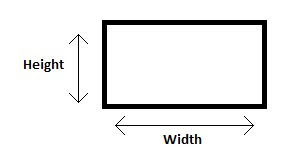 So if an image is 16 centimetres wide, and 9 centimetres high, then it is said to have an aspect ratio of 16x9. Often, for easy comparison, these are a reduced to a fraction of X:1, for example, 16x9 is approximately 1.78:1
When a movie or TV film is being produced, it is decided which aspect ratio it'll be filmed in. Three common aspect ratios (though by no means all), are 1.33:1 (4x3), 1.78:1 (16x9) and 2.35:1. Your TV screen also has an aspect ratio. Thus, letter boxing (which can be both horizontal and vertical) occurs when the aspect ratio of the picture your watching does not match the aspect ratio of your screen. For example:
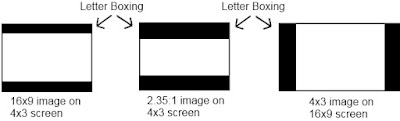
TV content is generally filmed in 4x3 and 16x9 aspect ratios, while movies tend to be 16x9 or 2.35x1. TV and computer monitors are generally 4x3 or 16x9. Another popular screen size (especially on laptops) is 16x10.
I remember renting movies and watching them on VHS tapes. Just before the movie would start, you would see a friendly message on the screen stating "This film has been modified from it's original version. It has been formatted to fit this screen."
I never used to understand what it meant (though I also used to think the quick FBI warnings said "If you watch this tape backwards you will lose your memory") until my brother explained to me one time that "it means you won't get those stupid black bars on the top and bottom".
Later on, we began to rent more and move movies which had the so called "stupid black bars", and every shot, someone would complain about it at the beginning of the movie.
Usually however, once the movie began you didn't notice it as much, but that still didn't mean we liked it. In the early 2000's, the switch was made to DVD's which often, nicely, provided both "wide screen" and "full screen" versions, the wide screen usually referring to a 16x9 aspect ratio, and the full screen referring to 4x3. My Dad used to say that "wide screen" should be called "narrow screen" since half of it was missing. Some DVD's would even have both versions on the same screen, allowing you to choose on the disc. Eventually (around 2006 and much to my dismay) I believe DVD's stopped coming in both formats and came in wide screen only. And, 16x9 was rare, most DVD's were now only available in their native, filmed format of 2.35x1.
This meant that if you had a 4x3 TV, 2.35:1 wasn't just wide screen, it was really wide screen. You needed to upgrade your TV to a 16x9 model, just to lessen (but not remove) the letter boxing. When we had 4:3 TV's, you had to deal with 16x9 letter boxing, and when we got 16x9 TV's, you had to deal with 2.35:1 letter boxing! It's a no win situation, and getting worse with the advent of HDTV's (1080p/i is 16x9 in case you are wondering).
Now, not everyone (unlike my family members) hates letter boxing. Some argue that they prefer to see the movie as it was shown in theaters, as the director intended it, for artistic reasons. They argue that it's actually the cropping that cuts out "half the movie", and not watching it in "wide screen".
That's fine and dandy, if they want to watch the movie that way, let them. But personally, I believe in giving people the choice of aspect ratio they'd like to watch the movie in. And I think the solution to this is much simpler then you might think.
Solving letter boxing
It might seem like the only way to avoid letter boxing would be with some sort of projector, or having a TV of every possible ratio! But there are other solutions.
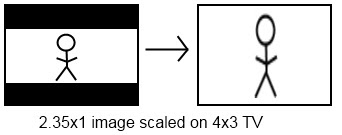
Many TV's now have the ability to "scale" the image. That is, they take the 2.35x1 image and stretch it to take up all of the 16x9 screen (or same with the 2.35x1 on a 4x3 screen). Personally, I don't like this option, as much as I dislike letter boxing, I dislike even more seeing the movie distorted:
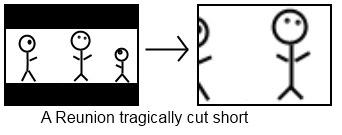
Another option is cropping. Often, your player will have the ability to "zoom" in on the image. This can work to some success, but the problem here is that sometimes you cut out important things on the screen.
Some DVD's player support a "pan and scan" option which allows you to actually sweep across the entire image as it's playing, but I don't really want to have to manually control this while watching a movie either.
Couldn't we simply get them to agree?
Fat chance. There are multiple motivations for choosing an aspect ratio for a program or film, both artistic and financial. It's highly unlikely that we'll ever see an agreed upon aspect ratio for all video content. In addition, it's impractical to produce a different physical version for every aspect ratio. And even then, if you had the 4x3 version but decided later to get a 16x9 TV, suddenly your 4x3 version is obsolete.
And why should we? We're asking for the freedom to watch in the aspect ratio we wish. The creators, really, should be allowed to produce in any aspect ratio we wish. So how do we find common ground?
The solution is actually surprisingly simple, and, it's entirely software based. All we need to do is provide one copy of the video content, in whatever aspect ratio the creator wishes. Then, we use an automatic (on the fly) combination of zooming and scaling to nicely format the image into the desired aspect ratio to watch.
For example, let's say I'm watching a 2.35:1 movie on my 4:3 TV. Along with the single video file would be a text file that mapped what part of the image should be displayed at what time to my aspect ratio. For example, from 5:34 to 6:02 in the movie, the top left of the 4:3 "view window" should be 100 pixels down and 43 pixels over, then from 6:02 to 6:40, it should be 300 pixels over and 90 pixels down.
It's like the zoom method mentioned above, but instead of the entire film being zoomed onto the same spot within the larger image, the player would read from the text file and move zoomed section around the movie, seamlessly (e.g. during pans or transitions) to keep the most relevant sections in frame. Further more, this text file could be easily set up like a table, to have different mappings on my 16x9 TV for the exact same 2.35:1 source film (or have a different file for a different aspect ratio). In some extreme cases, we could also use scaling on parts of the image, but then add it with the zooming to prevent distortion.
Would be this be a lot of work to add to video content? I don't believe so, certainly no more work then doing a "full conversion" for a different aspect ratio like what used to be done. This is essentially the same thing as that conversion, the difference being in the old method the various "crops" were cut together to make a new version of the movie, since the electronics from the older analog display methods (VHS for example) weren't sophisticated enough for this. But with the age of digital media, this is entirely possible. The player merely needs to be updated to read from these cropping files and display the correct part of the source image.
And, as long as the protocol was open and usable by anyone, this could be a community driven effort. It only takes one person a little bit of time to cut their movie from the source into the aspect ratio of their choice, then publish it for others to use. Then, the next person searches a database for the "crop" file for their movie in their aspect ratio, feeds it to their player and watches away. Don't like the cropping decisions they made? Make your own, if you wish, then publish it for others to use. People could rate them and leave comments, which could ultimately result in a final "best" copy. Or, you can easily hit a button and, like magic, the original, non cropped version will play.
In fact, the cropping process itself might even be able to be automated with software (though I still like the idea of being able to do it yourself in case you don't like the decisions the software makes)
So there you go, a nice, laid out solution to matching aspect ratios between source images and display devices! No more letter boxing necessary. Will studios/equipment manufactures pick up on this idea? Perhaps not...but we can dream. It's certainly not an unsolvable problem, alas, for the time being we'll just have to muddle along.
Surely you are familiar with letter boxing. It's been evident on many movies watched at home since the early 90's (perhaps earlier, but I haven't been watching movies that long).
What causes letter boxing?
Letter boxing is related to something called the "aspect ratio". This refers, simply, to the ratio of the width of an image compared to it's height:
 So if an image is 16 centimetres wide, and 9 centimetres high, then it is said to have an aspect ratio of 16x9. Often, for easy comparison, these are a reduced to a fraction of X:1, for example, 16x9 is approximately 1.78:1
When a movie or TV film is being produced, it is decided which aspect ratio it'll be filmed in. Three common aspect ratios (though by no means all), are 1.33:1 (4x3), 1.78:1 (16x9) and 2.35:1. Your TV screen also has an aspect ratio. Thus, letter boxing (which can be both horizontal and vertical) occurs when the aspect ratio of the picture your watching does not match the aspect ratio of your screen. For example:

TV content is generally filmed in 4x3 and 16x9 aspect ratios, while movies tend to be 16x9 or 2.35x1. TV and computer monitors are generally 4x3 or 16x9. Another popular screen size (especially on laptops) is 16x10.
I remember renting movies and watching them on VHS tapes. Just before the movie would start, you would see a friendly message on the screen stating "This film has been modified from it's original version. It has been formatted to fit this screen."
I never used to understand what it meant (though I also used to think the quick FBI warnings said "If you watch this tape backwards you will lose your memory") until my brother explained to me one time that "it means you won't get those stupid black bars on the top and bottom".
Later on, we began to rent more and move movies which had the so called "stupid black bars", and every shot, someone would complain about it at the beginning of the movie.
Usually however, once the movie began you didn't notice it as much, but that still didn't mean we liked it. In the early 2000's, the switch was made to DVD's which often, nicely, provided both "wide screen" and "full screen" versions, the wide screen usually referring to a 16x9 aspect ratio, and the full screen referring to 4x3. My Dad used to say that "wide screen" should be called "narrow screen" since half of it was missing. Some DVD's would even have both versions on the same screen, allowing you to choose on the disc. Eventually (around 2006 and much to my dismay) I believe DVD's stopped coming in both formats and came in wide screen only. And, 16x9 was rare, most DVD's were now only available in their native, filmed format of 2.35x1.
This meant that if you had a 4x3 TV, 2.35:1 wasn't just wide screen, it was really wide screen. You needed to upgrade your TV to a 16x9 model, just to lessen (but not remove) the letter boxing. When we had 4:3 TV's, you had to deal with 16x9 letter boxing, and when we got 16x9 TV's, you had to deal with 2.35:1 letter boxing! It's a no win situation, and getting worse with the advent of HDTV's (1080p/i is 16x9 in case you are wondering).
Now, not everyone (unlike my family members) hates letter boxing. Some argue that they prefer to see the movie as it was shown in theaters, as the director intended it, for artistic reasons. They argue that it's actually the cropping that cuts out "half the movie", and not watching it in "wide screen".
That's fine and dandy, if they want to watch the movie that way, let them. But personally, I believe in giving people the choice of aspect ratio they'd like to watch the movie in. And I think the solution to this is much simpler then you might think.
Solving letter boxing
It might seem like the only way to avoid letter boxing would be with some sort of projector, or having a TV of every possible ratio! But there are other solutions.
Many TV's now have the ability to "scale" the image. That is, they take the 2.35x1 image and stretch it to take up all of the 16x9 screen (or same with the 2.35x1 on a 4x3 screen). Personally, I don't like this option, as much as I dislike letter boxing, I dislike even more seeing the movie distorted:

Another option is cropping. Often, your player will have the ability to "zoom" in on the image. This can work to some success, but the problem here is that sometimes you cut out important things on the screen.


Some DVD's player support a "pan and scan" option which allows you to actually sweep across the entire image as it's playing, but I don't really want to have to manually control this while watching a movie either.
Couldn't we simply get them to agree?
Fat chance. There are multiple motivations for choosing an aspect ratio for a program or film, both artistic and financial. It's highly unlikely that we'll ever see an agreed upon aspect ratio for all video content. In addition, it's impractical to produce a different physical version for every aspect ratio. And even then, if you had the 4x3 version but decided later to get a 16x9 TV, suddenly your 4x3 version is obsolete.
And why should we? We're asking for the freedom to watch in the aspect ratio we wish. The creators, really, should be allowed to produce in any aspect ratio we wish. So how do we find common ground?
The solution is actually surprisingly simple, and, it's entirely software based. All we need to do is provide one copy of the video content, in whatever aspect ratio the creator wishes. Then, we use an automatic (on the fly) combination of zooming and scaling to nicely format the image into the desired aspect ratio to watch.
For example, let's say I'm watching a 2.35:1 movie on my 4:3 TV. Along with the single video file would be a text file that mapped what part of the image should be displayed at what time to my aspect ratio. For example, from 5:34 to 6:02 in the movie, the top left of the 4:3 "view window" should be 100 pixels down and 43 pixels over, then from 6:02 to 6:40, it should be 300 pixels over and 90 pixels down.
It's like the zoom method mentioned above, but instead of the entire film being zoomed onto the same spot within the larger image, the player would read from the text file and move zoomed section around the movie, seamlessly (e.g. during pans or transitions) to keep the most relevant sections in frame. Further more, this text file could be easily set up like a table, to have different mappings on my 16x9 TV for the exact same 2.35:1 source film (or have a different file for a different aspect ratio). In some extreme cases, we could also use scaling on parts of the image, but then add it with the zooming to prevent distortion.
Would be this be a lot of work to add to video content? I don't believe so, certainly no more work then doing a "full conversion" for a different aspect ratio like what used to be done. This is essentially the same thing as that conversion, the difference being in the old method the various "crops" were cut together to make a new version of the movie, since the electronics from the older analog display methods (VHS for example) weren't sophisticated enough for this. But with the age of digital media, this is entirely possible. The player merely needs to be updated to read from these cropping files and display the correct part of the source image.
And, as long as the protocol was open and usable by anyone, this could be a community driven effort. It only takes one person a little bit of time to cut their movie from the source into the aspect ratio of their choice, then publish it for others to use. Then, the next person searches a database for the "crop" file for their movie in their aspect ratio, feeds it to their player and watches away. Don't like the cropping decisions they made? Make your own, if you wish, then publish it for others to use. People could rate them and leave comments, which could ultimately result in a final "best" copy. Or, you can easily hit a button and, like magic, the original, non cropped version will play.
In fact, the cropping process itself might even be able to be automated with software (though I still like the idea of being able to do it yourself in case you don't like the decisions the software makes)
So there you go, a nice, laid out solution to matching aspect ratios between source images and display devices! No more letter boxing necessary. Will studios/equipment manufactures pick up on this idea? Perhaps not...but we can dream. It's certainly not an unsolvable problem, alas, for the time being we'll just have to muddle along.
Subscribe to:
Posts (Atom)